Sep 19, 2026
Hypoallergenic Memory Foam Pillows: How B2B Buyers Back the Claim With Documents
How B2B buyers support a hypoallergenic memory foam pillow claim: foam certificates, OEKO-TEX cover documents, washable construction and safe claim wording.
"Hypoallergenic" is one of the strongest selling words in bedding, and one of the weakest in law: in most markets it has no single binding definition, which means whoever prints it owns whatever the shopper thinks it means. For a B2B buyer that is a risk, not a feature — unless every implication of the word is anchored to a document you hold. This guide sets out which documents support which part of the claim, how to word the claim so it survives marketplace review, and what to check on the sample before the wording goes to print.
The Word Is a Claim, and the Claim Is Yours
The first discipline is ownership: the factory supplies materials, but the retail wording is published by the importer.
- **The claim travels with your packaging** — whatever the box, insert, and listing say, that is what regulators, platforms, and customers will test.
- **"Hypoallergenic" promises less irritation, not zero allergy** — treat it as a reduced-risk statement that needs evidence, never as a guarantee.
- **Vague adjectives expire fast** — a claim without a named document behind it is indefensible the first time a platform asks for substantiation.
- **The supplier's job is documentation** — make it explicit at quotation stage that certificates and fabric data are part of the deliverable.
Buyers who decide the wording early, and collect the documents to match, turn a risky adjective into an ordinary specification.
Anchor Every Claim to a Document
Work backwards from the wording you intend to print: each phrase should point at one named document.
- **"Certified low-emission foam"** → the foam certificate package for the core, issued to the producing factory.
- **"Cover tested for harmful substances"** → an OEKO-TEX STANDARD 100 certificate covering the actual fabric article.
- **"Removable, washable cover"** → a construction fact confirmed on the sample and reflected in printed care instructions.
- **"Baby-safe materials"** → the strictest applicable class of the same textile certificate, not a looser general one.
If a phrase on your draft packaging has no document behind it, delete the phrase or request the document before production.
Foam Documentation: What to Collect
The core is the easier half of the claim to document, because recognised foam certifications already exist.
- **CertiPUR-US or equivalent** — low-emission foam tested without a list of prohibited substances; request the certificate itself, not a summary.
- **Check the holder and validity** — the certificate must name the producing factory and be inside its renewal window; a logo in an email is not a document.
- **Match the certificate to the product** — the foam in your sample should be the foam the certificate describes; note that a separate deep-dive on comparing these two certificates already exists in this series.
- **Keep the chain for reorders** — if the foam source changes mid-program, the document chain must change with it.
Collect the foam documents once, properly, and they carry every claim you will ever print about the core.
The Cover Textile: OEKO-TEX and What It Actually Says
The cover does most of the touching, so most buyer questions land here.
- **What the certificate means** — OEKO-TEX STANDARD 100 tests the textile article, thread and accessories included, for a long list of harmful substances.
- **Class matters** — the classes run from I (baby articles, strictest) to IV; a kids' pillow program should sit in Class I, and the certificate must say so.
- **Request it for the actual fabric** — a certificate for a mill's general range is not a certificate for your cover; ask for the document naming the specific article.
- **Keep fibre content in writing** — the blend percentages on the spec sheet support both the care label and the claim copy.
Washability: The Claim You Can Demonstrate
Washability is the most practical allergen-related claim, because it is a construction fact you can show rather than a promise you must defend.
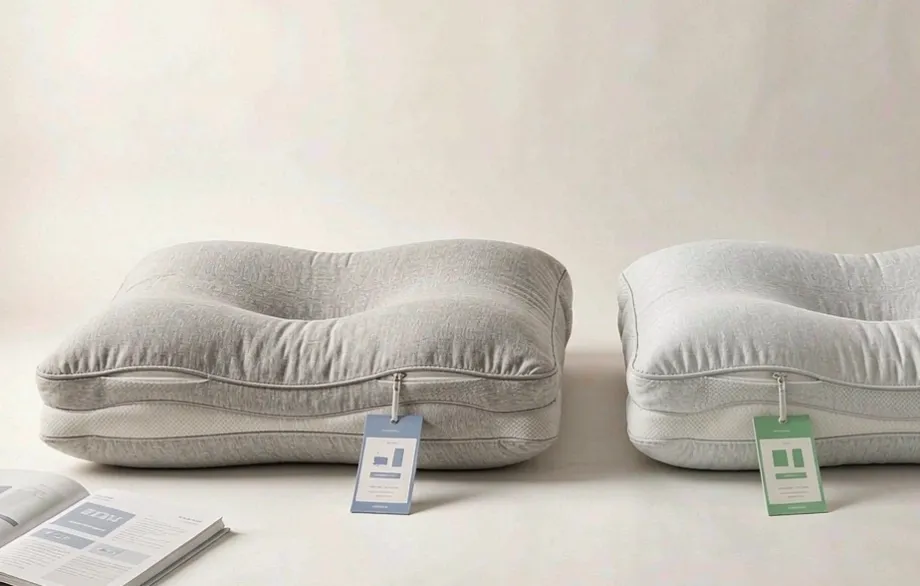
- **Removable covers with zippers** are standard across this product line — the feature is documentable with a photo, not an adjective.
- **Print care instructions from the supplier's written guidance** — cooling knits and coated fabrics have limits; the label must match them exactly.
- **Wash the sample once** before approving the claim; pilling, stretch loss, or a deformed core ends the washability story immediately.
- **A dense solid foam core is a design characteristic** — fewer crevices than loose fill; if you want to state more than that, ask the supplier for supporting test data rather than asserting it.
Safe and Unsafe Wording, Side by Side
The wording is where most programs fail review, and the fix is mechanical.
- **Safe:** "cover certified to OEKO-TEX STANDARD 100", "made with certified low-emission foam", "removable washable cover with zipper", "meets Class I requirements for baby articles" (only with the Class I certificate in hand).
- **Unsafe:** "anti-allergy", "prevents asthma or eczema", "dust-mite proof", "chemical-free", and any percentage claim ("removes 99% of allergens") without a test you can produce.
- **Platform rules bite first** — major marketplaces restrict disease and health-effect claims in bedding; certificate-anchored copy passes review without argument.
- **One claim, one document, one place** — repeating a claim in three places multiplies the review surface, not the trust.
Write the claim set once, attach the documents, and freeze it for the season.
Sample Checks Before You Print
Approve the physical sample against the same list that supports the wording.
- **Work the zipper ten times** — a cover that claims removability must survive the shopper's first attempt.
- **Remove and refit the cover** — check the foam returns to shape and the seams hold.
- **Run one wash cycle** on the labelled instructions and re-inspect.
- **Read your own label copy against the documents** — certificate names, classes, and care symbols must match the paperwork exactly.
- **Hold the signed sample** as the reference for bulk inspection and as evidence of what the claim described.
Common Mistakes With Hypoallergenic Programs
The same four errors recur:
- **Printing the adjective before collecting the documents** — then retrofitting evidence under deadline pressure.
- **Using a general-range textile certificate instead of the fabric's own** — it will not match the article name on audit.
- **Adding antimicrobial treatments casually** — treated articles carry their own regulatory regime in many markets; do not add the claim without the compliance work behind it.
- **Pairing baby SKUs with a lower certificate class** — the strictest class exists for a reason, and retailers check it.
Conclusion & Next Step
A hypoallergenic program is safe exactly as far as its documents reach: collect the foam certificate package, the cover textile certificate at the right class, and written care guidance, word every claim to point at one of them, and prove the construction claims on a wash-tested sample before anything goes to print.
Talk to our sourcing team on WhatsApp **+86 135 8471 3740** for foam and cover documentation, washable cover constructions, and claim-safe wording for your target market.