Sep 19, 2026
Building a Memory Foam Pillow Range: How to Tier Good, Better, Best for Retail and E-commerce
A B2B guide to building a tiered memory foam pillow range: what separates good, better and best tiers on foam, cover, packaging and certification without duplicating tooling.
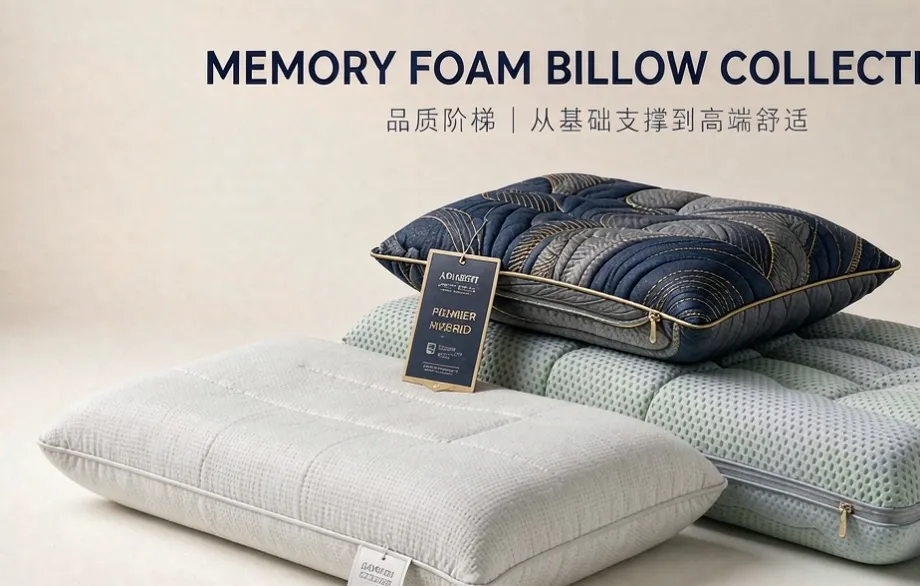
A single hero pillow rarely builds a business. Buyers who grow past their first container almost always end up with a range, because one product cannot serve a value shelf, a mid-market listing, and a premium hotel program at the same time. The mistake is building three products that cost three times as much to develop. Done properly, a tiered range reuses the same core platform and pays for itself in margin mix.
Why a Tiered Range Beats a Single Hero Product
Tiering is a margin strategy, not a product-count strategy.
- **One price point caps your ceiling.** A single SKU either prices out value shoppers or leaves premium margin on the table.
- **Tiers let buyers self-select.** Most shoppers trade up when the step is visible and justified.
- **Differentiation protects your listing.** A range with clear tiers is harder for a competitor to undercut on a single comparable SKU.
The goal is three clearly separated steps, not three similar pillows at three prices.
Tier 1 (Good): The Volume Driver
The entry tier exists to win the shelf and drive unit volume, not to carry margin.
- **Core** — entry-grade memory foam, typically in the 40–50 kg/m³ band, with a medium loft that suits the widest group of sleepers.
- **Cover** — a basic removable knit or polyester cover with standard stitching.
- **Packaging** — plain or simple printed packaging, carton-optimised for freight.
- **Role** — meet the entry price point reliably and protect the landed cost.
Keep this tier simple. Every feature you add here either raises cost or cannibalises the tier above it.
Tier 2 (Better): The Margin Engine
This is where most of the profit in a range is actually made.
- **Core** — mainstream density, commonly 50–60 kg/m³, which materially improves service life over the entry tier.
- **Cover** — a step up in fabric hand-feel and GSM, ideally removable and washable, often with a cooling finish.
- **Options** — offer a contour or cervical option here, since ergonomic shapes justify a visible price step.
- **Packaging** — branded retail packaging that reads as a deliberate product rather than a commodity.
Target this tier at the middle of your channel's price band, where volume and margin both hold.
Tier 3 (Best): The Halo Product
The top tier sells in lower volume but sets the ceiling for everything below it.
- **Core** — higher density foam, or a latex or latex-blend core for a distinctly different feel.
- **Cover** — premium textile such as a bamboo-derived viscose or lyocell blend, with better finishing.
- **Support** — a cervical contour with two deliberate heights, or a loft and firmness clearly aimed at a specific sleeper type.
- **Packaging and terms** — gift-box presentation and a longer stated warranty period.
Its job is to make tier two look like good value, so resist the urge to make it merely a slightly bigger version of tier two.
Differentiating Tiers Without Duplicating Tooling
The economics of a range depend on sharing the platform.
- **Reuse the core mould** across tiers where possible, and differentiate by foam density, loft, and cover rather than by entirely new tooling.
- **Change the cover, not the core** for the cheapest visible upgrade — fabric is the first thing a shopper touches.
- **Escalate packaging** at each step; it is one of the lowest-cost ways to signal a tier difference.
- **Confirm MOQ per variant**, because splitting one production run into three covers or densities can push you into a higher minimum per variant.
Matching Tiers to Channel and Price Points
Different channels consume different parts of the range.
- **Value retail** — tier one dominates, with tier two as a trade-up option.
- **Mid-market e-commerce** — tier two is the core listing, with tier one as the entry price hook and tier three for reviews and halo.
- **Hospitality and premium** — tier three, or a contract-specific variant of tier two with a longer warranty.
Decide the channel first, then set how many tiers that channel will realistically carry.
Packaging and Certification by Tier
Compliance should not vary by tier, but the documentation you show can.
- Keep **CertiPUR-US** on the foam and **OEKO-TEX STANDARD 100** on the cover across all tiers — compliance is not a luxury feature.
- Escalate the **presentation** of certification: a small mark on entry packaging, a prominent panel on premium packaging.
- Make sure any **warranty statement** matches the tier's actual construction, not an aspirational number.
Common Tiering Mistakes
Four errors undermine most new ranges:
- **Tiers too close together** — shoppers cannot see the difference, so everyone buys the cheapest.
- **A gap in the middle** — a jump from entry straight to premium leaves the margin tier empty.
- **Over-featuring the entry tier** — which cannibalises your own best sellers.
- **Ignoring per-variant MOQ** — turning three tiers into three unaffordable minimums.
Conclusion & Next Step
A good range is three clearly separated steps built on one shared platform: entry tier for volume, mid tier for margin, top tier for halo. Differentiate with foam density, cover, and packaging before you commission new tooling, and check the per-variant MOQ before committing.
Talk to our sourcing team on WhatsApp **+86 135 8471 3740** for tiered range specifications, cover and packaging options, and MOQ per variant tailored to your channel.