Amazon FBA Memory Foam Pillow Prep Checklist: Unit Pack, FNSKU and Carton Control
Control FNSKU labels, textile unit bags, vacuum-pack evidence and master-carton data before your China-made memory foam pillows ship to Amazon FBA.
Amazon FBA treats a memory foam pillow as a receiving unit, not simply as a finished foam product. For a China factory order, the preventable failures begin when the unit pack, barcode route and final carton specification are treated as logistics paperwork after bulk packing has started.
Current Amazon guidance requires items to be securely packaged and scannable, while textiles may need bagging under the applicable product-specific prep rules. The purchasing control is a buyer-approved FBA packout revision issued before the factory prints labels, seals units or orders cartons.
1. Set One FBA Packout Revision for Each SKU
The buyer should first choose the barcode route in Seller Central, then send the factory the approved label files, placement drawing and revision code. FNSKU, manufacturer barcode and Transparency barcode routes are not interchangeable, and the factory should never select one from a product title or an old artwork file.
Treat the FBA packout as part of the purchase-order BOM. It should identify the sellable SKU, final unit-pack format, barcode route, label position, bag requirement, warning artwork, case-pack rule and master-carton data.
The following table is a production-control worksheet, not a substitute for the current Seller Central guidance for the target marketplace and ASIN.
| FBA Packout Field | Buyer Must Freeze Before Bulk Packing | Factory Release Evidence | PO Hold Point |
|---|---|---|---|
| Barcode route | FNSKU or the eligible manufacturer-barcode route selected for the listing | Current buyer-supplied label PDF, scan result and photo of one sealed unit | Do not print before the buyer approves the file revision |
| Existing UPC or EAN | State whether the existing code remains scannable or must be covered | Annotated photo of the finished unit pack | No competing readable code on the final unit when the buyer requires FNSKU control |
| Textile unit bag | Clear, fully sealed bag sized for the packed pillow and the current marketplace prep rule | Bag material specification, closure photo and barcode visibility check | No unsealed or overhanging bag accepted at final packout |
| Warning artwork | Applicable marketplace warning text, language and placement approved by the seller | Final artwork revision and sealed-unit photo | No label substitution after sample approval |
| Case pack | Matching SKU, condition and unit count when the shipment is case packed | Carton packing record and count confirmation | No mixed SKUs or quantities in an approved case pack |
| Master carton | External L x W x H, NW, GW, carton mark and shipment workflow | Closed-carton measurement, packing photo and final packing list | Freight quote and shipment release use the measured carton, not an estimate |
2. Approve the Pillow as a Received Unit, Not an Unpacked Sample
An unpacked development sample can confirm the core profile, cover and feel, but it does not prove that the unit can be received by FBA. The buyer needs to inspect the same vacuum-packed or retail-packed configuration that will carry the final label and move through the shipping lane.
Place the scannable label on a smooth, flat area of the final unit pack. Amazon's current seller guidance specifies a readable barcode label, rejects damaged or photocopied labels, and says that labels must remain accessible on the outside of any additional packaging.
For memory foam pillows, review the label after the bag has been sealed and after the packed unit has been held under the planned compression condition. A label that scans on a loose sample can wrinkle, lift or become difficult to scan after the bag geometry, compression ratio or retail sleeve changes.
Use the vacuum packaging test guide to connect recovery, seal integrity and packed dimensions to the final sellable-unit pack. The FBA label and the vacuum-pack specification should be approved as one configuration.
3. Separate Unit Labels, Carton Labels and Shipment Labels
The buyer controls the listing-specific barcode decision and supplies the approved unit-label artwork. The factory controls physical placement, scans the sealed unit and documents the approved packout; a freight forwarder or prep partner may apply shipment-stage labels only after the buyer creates the inbound plan.
Do not combine these files into one generic "Amazon label" folder. A unit FNSKU identifies the sellable product, whereas carton and shipment labels depend on the current inbound workflow and can change after the product artwork is already frozen.
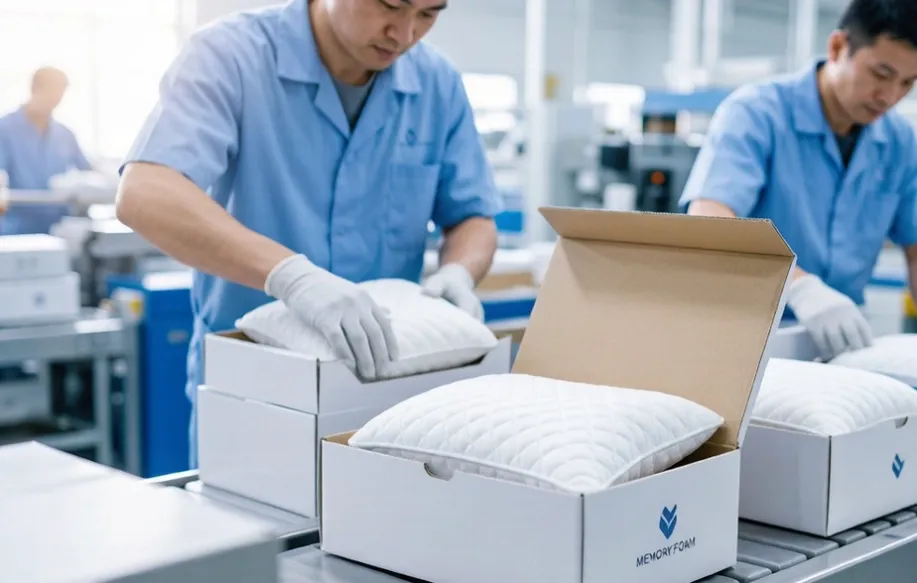
Ask for a short pre-production packout file: one flat unit image showing the label position, one close-up that proves scanability, one image of the warning artwork where applicable, and one closed-carton image showing the case count and carton marks. A Free Mockup is useful for checking artwork and position, but it does not replace the physical sealed-sample check.
4. Add FBA Packout Checks to Pre-Shipment Inspection
The inspector should select random units from different cartons and compare them with the approved FBA packout revision. Check the barcode scan, label placement, bag closure, warning artwork, sellable-unit condition, carton count, carton marks and external carton dimensions.
For a vacuum-compressed pillow, add packed-unit dimensions, seal condition and recovery evidence to the same inspection file. The factory should not release a shipment based on a correctly labeled display sample if randomly selected production units use a different bag, carton quantity or artwork revision.
Use the bulk pillow pre-shipment inspection checklist for the wider AQL and defect-release plan. The buyer should also recheck the latest product-specific requirements in Seller Central before approving the production packout, because marketplace and ASIN-level prep guidance can change.
5. Put FBA Responsibilities Into the Purchase Order
Write ownership into the PO: the seller supplies the correct listing and label files; the factory applies only approved files and returns packout evidence; the forwarder or prep partner follows the final inbound instructions. This division prevents a common dispute in which each party assumes that another party is responsible for labels, warnings or carton data.
For a first order, hold a final packed sample until the buyer signs the FBA packout revision. On replenishment orders, keep the same revision unless a barcode, bag, label, carton or vacuum-pack change is formally approved and rechecked.
Our factory can prepare flexible small-batch pillow configurations, Free Mockups for branded unit packs, rapid samples and a controlled packout record. Send the target marketplace, ASIN or product listing status, barcode route, intended case pack and destination so we can return an OEM specification that separates product, packaging and freight decisions.
Explore Technical Specs for the Ergonomic Memory Foam Cervical Pillow