Aug 17, 2026Buyer Guides
Private Label Memory Foam Pillows: OEM Brand Approval & Packaging Workflow
A B2B OEM workflow for approving private-label memory foam pillow cores, covers, branding, packaging, certification scope, and reorder changes.
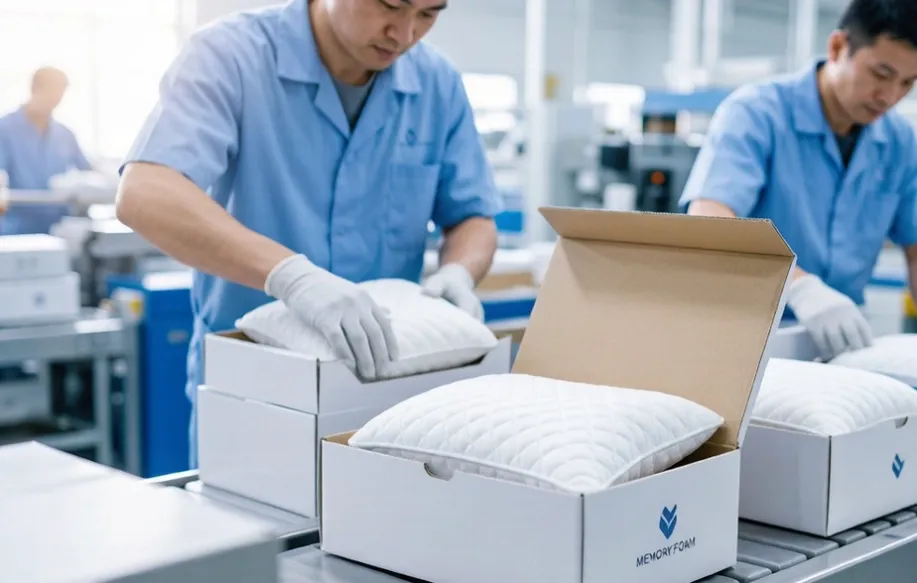
For Amazon FBA sellers, private-label founders, distributors and hotel procurement teams, a branded memory foam pillow program is a controlled sourcing project, not a logo-only exercise. The commercial risk sits in unapproved foam changes, unclear packaging ownership, unsupported certification claims and a reorder that no longer matches the approved sample.
This OEM workflow gives buyers a practical approval path from RFQ to repeat order. It keeps the foam core, cover, branding, packaging and compliance evidence under one revision-controlled record.
Define the Private-Label Scope Before the RFQ
Start with the sales channel, target market, pack-out requirement and expected reorder pattern. State whether the first order is a standard factory construction with private branding or a genuinely custom product that needs new tooling, non-stock fabric or a revised foam profile.
Send a concise specification sheet and ask the factory to mark each item as standard, available with setup, or requiring a new development step. This makes the quotation comparable and prevents a low-MOQ promise from hiding a separate component minimum.
- Core brief: dimensions, profile, density target, tolerance, core weight and recovery test condition.
- Cover brief: fabric composition, fabric weight, color reference, shrinkage, pilling, zipper and seam requirements.
- Brand brief: woven label or print method, logo artwork, care-label copy and placement drawing.
- Channel brief: unit packaging, barcode or FNSKU position, carton marks and destination documentation.
Separate the Core, Cover and Brand Components
A private-label pillow is usually a combination of components with different purchasing conditions. The foam core may be a standard construction while the cover fabric, label, insert and retail box carry the custom MOQ.
Ask for separate cost and MOQ lines for foam density, cover material, branding, packaging and any tooling. A buyer can then reduce launch risk by keeping the core standard while testing a custom brand layer.
- Foam: identify the approved material, density method, profile drawing and lot record.
- Cover: approve composition, shade, hand feel standard, seam construction and zipper operation.
- Logo: approve artwork scale, Pantone reference where relevant, stitch or print method and placement.
- Packaging: approve box or sleeve dimensions, insert copy, barcode position and master carton layout.
Approve Artwork and Packaging as Controlled Samples
Brand assets should be approved in the same way as the physical pillow. Record the artwork file name, revision date, color reference, label placement and packaging dieline in a Sample Approval Sheet.
Request a Free Mockup before printing and compare the mockup with the production artwork. The approval should state which files are released for bulk production and which earlier versions are obsolete.
- Artwork proof: logo scale, color reference, copy, barcode and language version.
- Physical sample: label attachment, cover fit, zipper access and unit-pack orientation.
- Carton proof: carton marks, units per carton, gross weight and shipping marks.
- Release rule: no bulk printing or packing against an unapproved revision.
Verify Certification Scope and Market Documents
Private labeling does not transfer a certificate automatically to the buyer. Ask which factory, material or component is covered, confirm the issue and expiry dates, and check that the document scope matches the ordered foam, cover and market.
For claims involving OEKO-TEX Standard 100, CertiPUR-US or an audit such as BSCI, retain the certificate, scope statement and supplier identity in the purchase-order file. Do not print a certification mark or make a market claim until the relevant document and artwork have been reviewed.
- Certificate scope: verify the named holder, covered component and valid dates.
- Market fit: confirm importer, labeling and documentation requirements for the destination.
- Traceability: retain the certificate and production-lot evidence with the order record.
- Artwork control: remove unsupported marks or claims from packaging before print release.
Scale Reorders Without Losing Revision Control
Before a reorder, compare the current quote, approved sample, foam lot, cover material, packaging file and carton data with the previous release. A component substitution should be treated as a change request, not as a silent production convenience.
Keep one owner for deviations and require written approval before the factory changes the foam, cover, trim, label, insert or carton. This protects the brand when a new material lot or packaging vendor enters the supply chain.
- Reorder check: compare the signed sample, revision code and component list.
- Inspection evidence: retain material records, first-off photos and final random inspection results.
- Freight inputs: reconfirm vacuum condition, Master Carton CBM, units per carton and gross weight.
- Corrective action: document owner, deadline and disposition for each deviation.
Our source factory supports flexible low-MOQ OEM programs, Free Mockup, rapid sampling and controlled label and pack-out approvals. Buyers receive a clear handoff from specification to sample and from approved sample to bulk production.
Related sourcing controls
Explore Technical Specs for Ergonomic Memory Foam Cervical Pillow
Request an OEM Pillow Specification
Request a Custom Bulk Quote